

Newaygo Public Schools Transportation
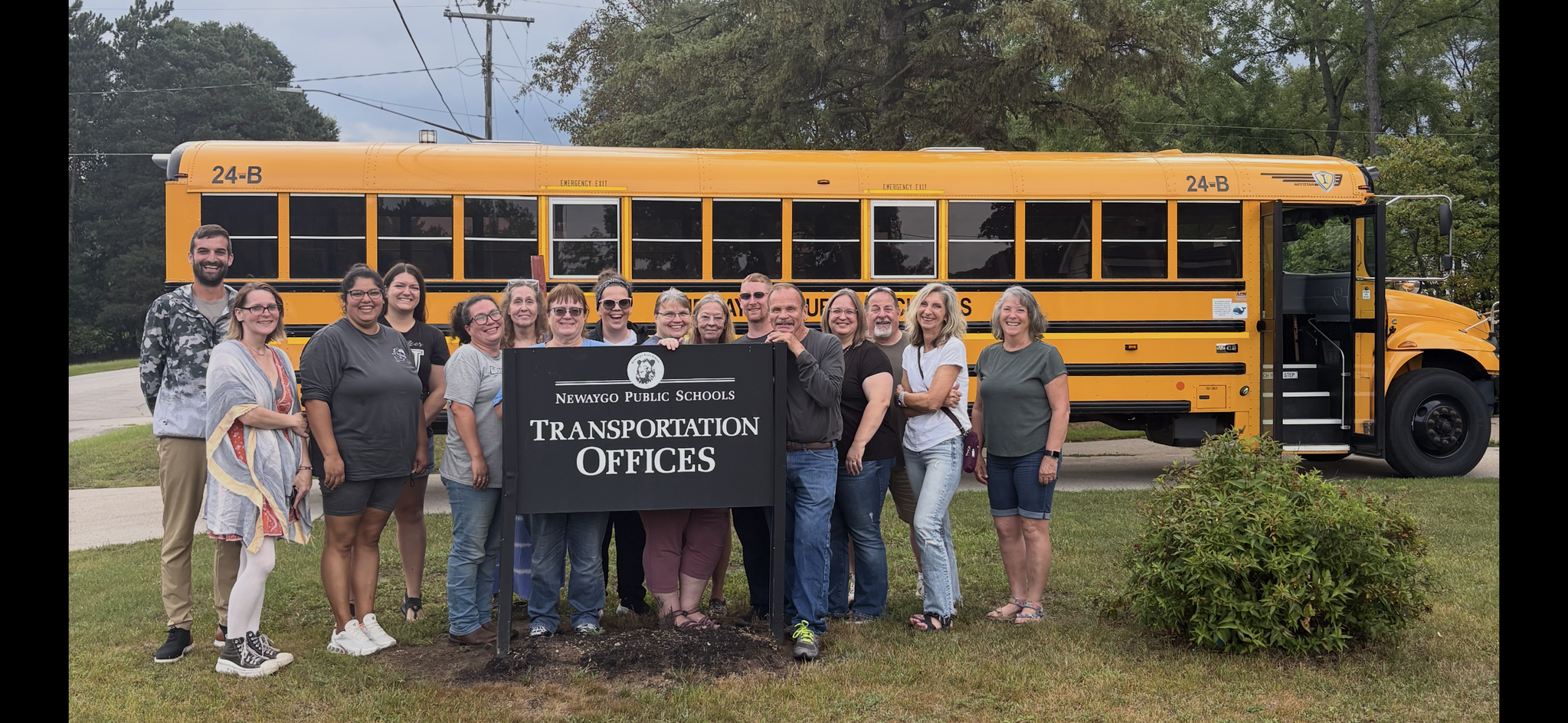
Welcome to the NPS Transportation webpage. Here at NPS, we have a fleet of buses that travel over 200,000 miles per year on 20 different regular routes. We are proud of our safety record and are committed to getting NPS students to and from school in a safe manner.
Due to the volume of miles traveled and the number of students served, the following guidelines must be followed.
Your child may be picked up at one location and dropped off at another, but it needs to be consistent each way.
We do not allow students to ride to another student's home. Students who live in the City of Newaygo may board a transfer bus at the nearest school building and ride to their school.
If a child needs a permanent change in pickup or drop-off location, please call Brandon Schultz at (231) 652-1112.
FAQs
Are school districts required to transport my child?
No, Michigan school districts are not universally required by law to transport regular education students. Under Michigan Compiled Law (MCL) 380.1321, providing school bus transportation is a local decision made by each individual school district's board of education. However, there are two major legal exceptions where transportation becomes mandatory.
1. Special Education Students: If your child has an Individualized Education Plan (IEP) and the IEP team determines that specialized transportation is a necessary service to accommodate their disability, the school district is legally obligated to provide it. This is mandated under Article 3 of the Revised School Code.
2. Equal Provision Rules: If a school board chooses to provide busing for its regular education public school students, it must follow strict state compliance rules. For non-public school students, the district must provide transportation to resident students attending a local, state-approved private school on the same basis as public school students.
3. The 1.5 Mile Rule: A district that provides busing is not required to transport any student (public or private) who lives less than 1.5 miles from their school, unless walking is deemed unsafe.
4. Schools of Choice: If you enroll your child in a public school outside your resident district through the Schools of Choice program, the district is generally not required to provide transportation.
Is there a law about how far my child has to walk to the bus stop?
No, there is no Michigan state law that specifies a maximum distance a student can be required to walk to a school bus stop. Michigan courts and state guidelines reiterate that it is the parent's legal responsibility to ensure a child travels safely between the home and the designated bus stop. The lack of sidewalks or a busy roadway does not legally obligate a district to change a stop or provide curbside pickup for general education students.
Is there a specified distance that must exist between school bus stops?
While the state doesn't limit your child's walking distance, the Michigan Pupil Transportation Act (MCL 257.1855) places strict rules on where the district can legally place a stop to ensure maximum visibility.
Distance Between Stops: School bus stops must be at least 200 feet apart by law.
Road Visibility: Stops cannot be placed on hills or curves where approaching motorists cannot see the bus. On roads with speed limits over 35 mph, there must be at least 400 feet of clear, continuous visibility. On roads 35 mph or less, there must be 200 feet of visibility.
Intersections and Signals: Buses are generally prohibited from stopping within 200 feet of an intersection (unless approved by administrators) or within 50 feet of a traffic signal.
When should my child be at the bus stop in the morning?
Your child should be at the bus stop exactly 10 minutes before the scheduled pickup time. Michigan Department of Education (MDE) guidelines and individual school district policies uniformly recommend arriving at least 10 minutes early to prevent missing the bus and to ensure an orderly boarding process.
Why do pick-up/drop-off times vary, especially at the beginning of the school year?
Pickup and drop-off times vary widely at the beginning of the school year because districts are adjusting to real-world conditions that cannot be perfectly predicted by routing software. The fluctuations usually stabilize within the first two to three weeks of school due to several specific logistic challenges:
1. Fluctuating Student Counts Inaccurate Rosters: Many parents delay enrolling their children or registering for busing until the final days before school starts. Software builds routes assuming every registered student will ride, but many families opt to drive their kids during the first week. Drivers must stop at empty designated locations, which alters the timeline.
2. Learning the Routines & Young Riders: Kindergarteners and elementary students take significantly longer to board, find seats, and learn bus safety rules during the first few weeks. At Loading Zones, school staff must meticulously check IDs and matching tags at dismissal to ensure young students board the correct bus, creating major afternoon departure delays.
3. Traffic and Driver Factors Community Traffic: General commuter traffic patterns spike dramatically during the first week of school as parents navigate new drop-off lines, causing local gridlock. Many bus drivers are navigating completely new routes, learning specific turnaround points, and adjusting to local construction delays.
4. Route Adjustments Consolidation: Transportation departments actively monitor the first two weeks of data to eliminate unused stops and split overloaded buses, which shifts pickup times.
Transportation Office Hours
Monday - Friday: 6:00am - 5:00pm
231-652-1112
Brandon Schultz
Transportation Director


